
If you live in Victorville, California, you know the desert dust never stops. The High Desert's unique geography — sitting at over 2,700 feet elevation in the Mojave Desert — creates a constant cycle of wind-blown sand, fine dust particles, and mineral-laden debris that settles on every exterior surface of your home. Your windows bear the brunt of this assault.
What's Actually in Victorville's Desert Dust?
Victorville's dust isn't just dirt. The particulate matter that settles on your windows is a complex mix of materials, each damaging in its own way:
Fine silica particles: These microscopic shards of glass-like material are carried by desert winds. When they settle on your windows and are disturbed by friction or wind, they create micro-scratches across the glass surface. Over time, these accumulate into a permanent haze.
Calcium carbonate: Pulled from desert soils and road surfaces, calcium particles form the white crust you see around window edges and on lower panes.
Pollen and organic matter: Spring months bring Joshua tree, creosote, and agricultural pollen. These sticky particles act as a binding agent that holds dust to glass surfaces more stubbornly than dust alone.
Vehicle exhaust particulates: Properties near Highway 395, Interstate 15, or Mojave Drive experience elevated concentrations of fine exhaust soot that bonds to glass on contact.
Victorville's Wind Patterns and Window Exposure
Not all sides of your home accumulate dust equally. Understanding local wind patterns can help you prioritize cleaning:
Southwest-facing windows take the hardest hit from the Mojave's prevailing southwesterly winds, which funnel through the Cajon Pass and accelerate across the Victor Valley floor.
North-facing windows experience more condensation and slower drying, which means mineral deposits from dew accumulate faster. Morning fog events (surprisingly common in the High Desert winter months) leave hard water deposits with every evaporation cycle.
Lower-story windows near irrigated landscaping collect the most hard water overspray from sprinkler systems.
Victorville's Hard Water Problem
The Victor Valley's water supply comes primarily from the Mojave River groundwater basin — one of the hardest water sources in Southern California. Total Dissolved Solids (TDS) in Victorville tap water regularly exceed 300-400 parts per million, compared to a national average of around 75 ppm.
This matters enormously for windows. When hard water from sprinklers, rain splash, or morning dew evaporates on your glass, it leaves behind crystallized calcium, magnesium, and silica compounds. These mineral deposits don't simply wipe away — they bond to the silica structure of the glass itself at a molecular level.
After 6 months, hard water deposits begin chemically etching glass surfaces. After 12+ months, the etching becomes permanent and requires professional glass restoration — not just cleaning.
DIY vs Professional Window Cleaning in the Desert
Many homeowners attempt to clean their own windows with a garden hose and dish soap. Here's why that makes things worse:
Tap water = more minerals: Every gallon of Victorville tap water you apply to your windows deposits more calcium and magnesium. When it dries, you've added to the problem.
Dish soap leaves residue: Soap residue creates a static charge that attracts more dust. Within days, your DIY-cleaned windows look worse than before.
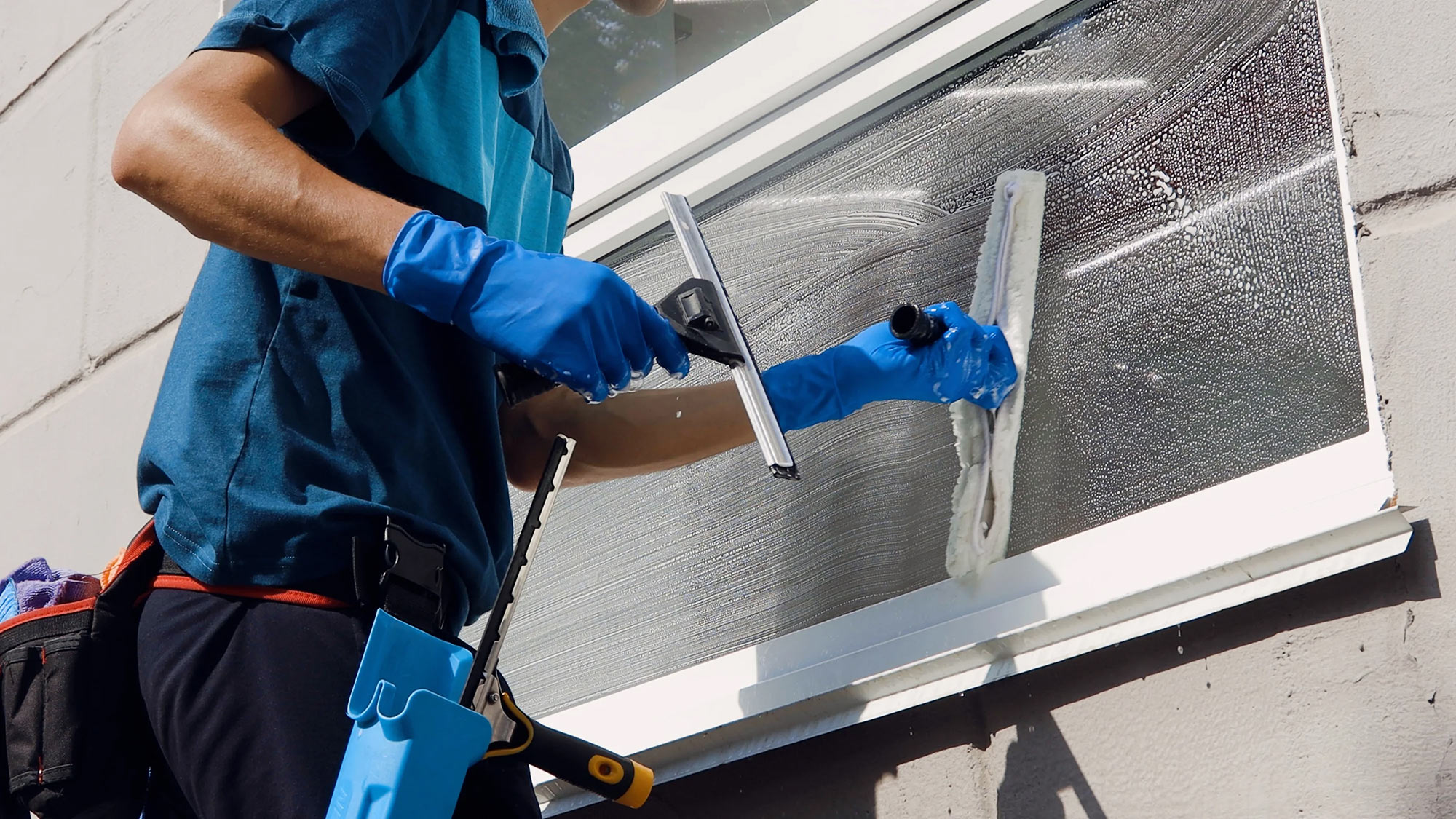
Wrong tools create scratches: Paper towels, cotton rags, and abrasive sponges drag grit across glass, amplifying micro-scratch damage.
Need professional window cleaning in Victorville? Call Blue Skye Cleaning — we use 0 TDS purified water and leave zero residue.What Professional Cleaning Does Differently
Professional window cleaning in the desert relies on pure water technology. Our multi-stage filtration system removes all dissolved minerals, producing water with 0 TDS. When this water evaporates, it leaves absolutely nothing behind — no spots, no streaks, no residue.
Our water-fed pole system delivers this purified water through soft-bristle brushes that agitate and lift dirt without scratching. We can safely clean second and third-story windows from the ground — no ladders, no scaffold.
For hard water mineral deposits already bonded to glass, we use specialized calcium-dissolution solution applied by hand before the pure water rinse.
How Often Should You Clean?
For most Victorville properties, we recommend:
- Standard residential homes: Every 3 months (quarterly)
- Properties near major roads (Highway 395, I-15, Mojave Drive): Every 6-8 weeks
- Homes with active sprinkler systems hitting windows: Every 6-8 weeks
- Commercial storefronts: Monthly
- After a major dust storm or wind event: Schedule a cleaning within 2 weeks
The Cost of Waiting Too Long
- Months 1-2: Dust accumulates. Easy to clean.
- Months 3-4: Hard water spots begin surface bonding. Requires professional treatment.
- Months 6-8: Mineral etching begins. More labor-intensive to remove.
- Months 12+: Permanent etching in glass. Requires professional glass restoration.
Regular quarterly cleaning is always more economical than glass restoration.
Prevention Between Cleanings
- Adjust sprinkler heads so they don't contact window surfaces
- Dust exterior sills monthly with a dry microfiber cloth
- Never use tap water if you must DIY — use distilled water only
- Schedule a professional cleaning within two weeks of any major wind event
Ready to protect your glass? Call Blue Skye Cleaning LLC at (702) 875-5767 for a free estimate on window cleaning in Victorville.
Blue Skye Cleaning LLC
READY TO GET STARTED?
Serving Victorville, Hesperia, Apple Valley & the High Desert